
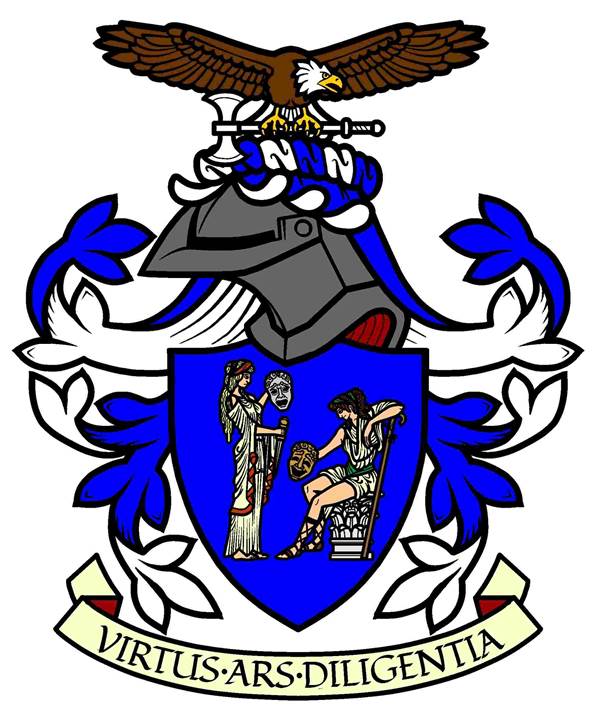
The Crest features a Bald Eagle clutching a Battle Axe in its talons. The Eagle is about to take flight, symbolizing aspiration and readiness to act. The image of the Eagle in motion conveys a sense of determination and vigilance.
The Eagle became our national symbol when the Second Continental Congress selected it as the U.S. National Symbol on June 20, 1782. They did so because bald eagles are unique to North America, making them our eagles; they are strong, independent, and survivors. They are majestic, bold, and faithful. They are a symbol of strength and determination. Chosen not only for those reasons listed above but also because our family has a history of supporting our country, from Abijah Virgil, who fought in the Revolutionary War, to George La Verne Virgil, who fought in World War II. But George is not the only person who has served our country recently. His sons Ken and Doug, as did his grandson Samuel, all served in the military. Therefore, it was logical to include the Bald Eagle in the Achievement and to place it in a prominent position, which is why it is part of the crest.
In the Great Seal of the United States, the eagle holds an olive branch in its right talon, symbolizing the nation’s commitment to peace. In its left talon, it grips 13 arrows, representing strength and readiness to defend if necessary. The eagle faces the olive branch—not the arrows—showing that peace is the country’s first choice, though it won’t back down from conflict when needed. But in this particular image, the eagle faces left—and that’s intentional.
By 1916, World War I had already thrown much of the world into chaos and rapidly changed the political and social landscape. The Battle of Verdun dragged on as one of the longest and bloodiest fights in history, and the Easter Rising in Ireland showed how unstable things were getting even within the British Empire. As these events unfolded, tension spread across the globe. Even though the U.S. stayed neutral, it couldn’t ignore what was happening. The pressure to get involved kept growing.
Seeing the writing on the wall, President Woodrow Wilson made a quiet but bold move. On May 28, 1916, he signed Executive Order 2390, changing the Presidential Seal so the eagle faced the arrows instead of the olive branch. That small detail clearly showed that the U.S. was preparing for war. Then, in early 1917, things escalated. Germany brought back unrestricted submarine warfare, threatening American lives and trade. In March, the British exposed the Zimmermann Telegram, Germany’s secret offer to help Mexico reclaim Texas, New Mexico, and Arizona if it joined the war against the U.S. The United States went to war against Germany on April 6, 1917.
The eagle on the Presidential Seal remained facing the arrows until 25 October 1945, when President Harry Truman issued Executive Order 9646, which established the modern presidential seal design. The eagle facing the olive branch symbolizes a preference for peace. However, President Truman did not issue the executive order until after Germany surrendered unconditionally to the Allies on 7 May 1945, and the Japanese surrendered unconditionally on 15 Aug 1945.
George’s crest features the eagle facing left, toward the arrows, reflecting the version of the Presidential Seal in use during his service. He served while the nation embraced its warrior stance—when the eagle symbolically looked to strength and defense. That detail in his crest honors the era’s spirit and his role in defending the country during the global conflict.
The Battle Axe carries rich symbolism, primarily representing strength, military prowess, and a readiness to defend one’s honor or homeland. As a weapon historically associated with warriors and executioners, the battle axe symbolizes brute force, authority, and justice. When depicted on a coat of arms, the bearer is prepared to fight or sacrifice for a just cause, indicating a person dedicated to defending their people and ideals.
It also embodies the notion of power tempered by responsibility. Unlike a sword, which is purely a weapon of war, the battle axe can be seen as a tool, suggesting that its bearer possesses practical qualities and can protect and provide for its people. This duality of its use as an instrument of labor and war enhances its meaning, implying balance and strength in action tempered by wisdom and justice in decision-making. Overall, the battle axe represents courage, leadership, and the readiness to defend or enforce justice.
The combination of the Eagle and the Battle Axe represents a martial prowess and readiness to defend freedom and justice at all costs. It is a powerful emblem for a nation, ruler, military leader, warrior, or family that values its sovereignty and the strength to protect it.


Leave a Reply